What Missed Calls Cost Your Business (2026): Work Out Your Number in 2 Minutes
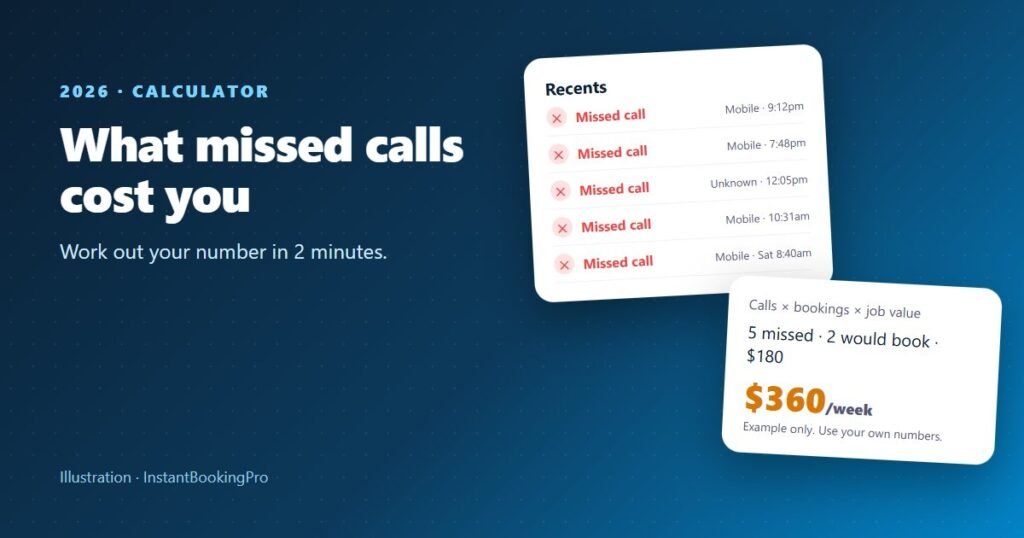
Missed calls cost service businesses real money, because many callers don’t leave a voicemail; they ring the next business on the list. To work out your number, multiply the calls you miss each week by how many of those callers would have booked, then by your average job value. Use the calculator below. The fixes, from a free missed-call text-back to online booking from $59 a month, usually cost less than the leak.
Missed call cost calculator
Enter your own numbers. The example values are an illustration, not data from any particular business.
Revenue at risk: $360 a week, $1,559 a month and $18,720 a year.
The formula: (callers who would have booked each week) × (average job value), then × 4.33 for a month or × 52 for a year. With the example numbers, 2 lost bookings a week at $180 is $360 a week, about $1,559 a month and $18,720 a year.
That’s the conservative version. It counts each lost caller as one job, but a regular client is worth many visits a year, so losing a potential regular compounds. If you’re a cleaner, see how online booking works for cleaning businesses.
Do customers call back if you miss them?
Often they don’t. A customer ringing around for a service usually has a short list from a Google search, and if you don’t answer, the next number is one tap away. Research published by call-answering and phone-system providers, who have an interest in the topic, points the same way: many calls to small businesses go unanswered, and many callers who reach voicemail don’t leave a message. Treat the exact percentages with caution and check your own call log. The best evidence is your own: count the missed calls you never heard from again.
When do customers try to book?
Most service business owners recognise the pattern: enquiries come in the evenings and on weekends, when people finally have time to sort out the house, the haircut or the leaking tap. That’s exactly when your phone is off. A booking channel that only works 8am to 5pm on weekdays is closed for many of the moments people are ready to book. Check your own call log for the times your missed calls arrive.
How to stop losing missed calls when nobody can answer 24/7
You can’t answer every call yourself: you’re working, driving or asleep. The realistic fix is giving the enquiry somewhere else to land. There are four options, and they’re not equivalent.
1. Missed-call text-back (cheapest)
A short text to every call you can’t answer reaches the caller while they’re still holding their phone, before they’ve dialled the next business. Many phone plans and apps can send it automatically; at worst, send it yourself when you see the missed call.
Tip: Keep it to one line: “Hi, sorry we missed your call. You can book a time that suits at [your booking link], or we’ll ring you back this arvo.” It apologises, gives an instant option and keeps the callback promise for people who’d rather talk.
2. Call answering service
Pros: a real person answers during covered hours, which suits complex enquiries and callers who prefer to talk. Cons: the operator usually can’t see your calendar, so they take messages rather than bookings, and per-call or after-hours pricing adds up.
3. AI receptionist
Pros: answers instantly, 24/7, and handles simple questions such as “are you open Saturday?”. Cons: quality varies a lot between products, some callers hang up on principle, and unless it’s connected to your live calendar it still ends in “someone will call you back”. Test it thoroughly before trusting it with first impressions.
4. Online booking
Pros: works 24/7 at a flat monthly price; customers see your real availability and book instantly, so there’s no callback step; every booking creates a customer record. Cons: some people want to talk first, and jobs you must see before pricing still need a conversation. It also has to be set up properly, which is where DIY tools lose people.
For most small service businesses, online booking plus a text-back removes most of the leak. InstantBookingPro plans start at $59 a month including GST, set up for you. See it working for salons and barbers and car washes and detailers, or try the live booking demo.
Watch out: Whatever answers your phone, the goal is a booked job, not a message. Any fix that ends with “we’ll call you back” keeps the step where customers drift away.
What to do this week
- Count your missed calls for one week Your phone’s call log makes this easy. Include the after-hours ones.
- Run the calculator with your own numbers Be honest about how many callers would really have booked.
- Set up a text-back and a booking link Follow our guide to taking bookings online in 7 steps, then add your Book now link to Instagram and Google.
- Recount a month later Your before-and-after numbers are your real return, not anyone’s industry statistic.
Comparing options? Our guides cover the best booking systems in Australia and what booking software really costs.
Stop missing bookings. We’ll build your branded booking page for you, typically live within 24 hours, so customers can book while you work. From $59 a month including GST.
Frequently asked questions
How much are missed calls costing my business?
Won’t a better voicemail greeting fix it?
Is an answering service, an AI receptionist or online booking better value?
Should I text back missed calls?
What about customers who won’t book online?
Do reminders reduce no-shows?
Get instant online bookings
We build and launch your branded booking system for you — typically live within 24 hours.