Cancellation Policy for a Small Service Business: What to Include (2026)
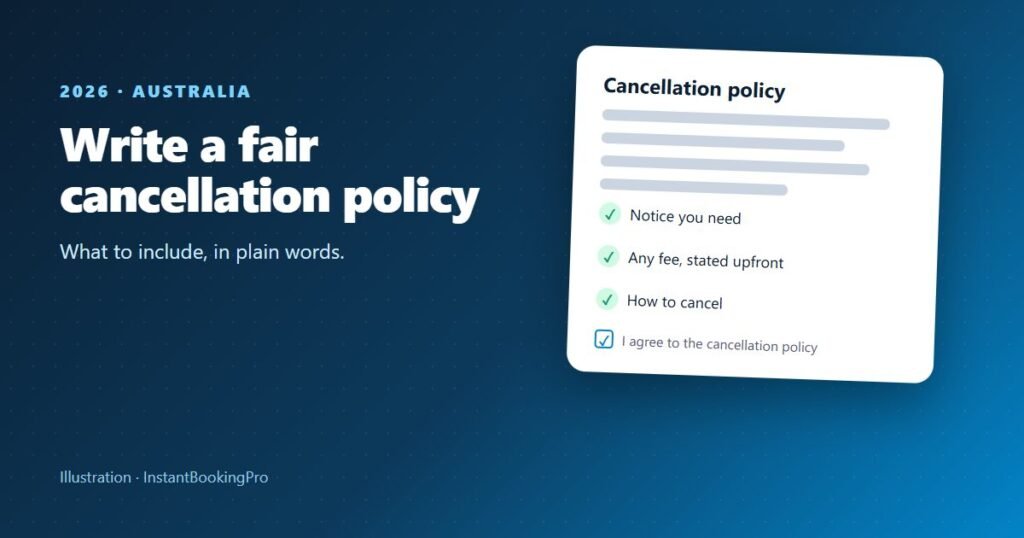
A cancellation policy for a small service business should say: how much notice customers need to give, how they cancel or change a booking, what happens if they cancel late or don’t turn up (and any fee or deposit, stated upfront and kept to your reasonable costs), what happens if you cancel or run late, and that customers’ consumer guarantee rights still apply. Show it before customers book and get them to agree. Avoid “no refunds” wording: the ACCC says policies like that are illegal. Official sources are linked below, checked 19 October 2026.
General information only. This guide isn’t legal advice, and the sample wording below is a starting point, not a legally checked template. business.gov.au recommends getting legal advice on what to include in your terms and conditions.
A good cancellation policy protects your time without scaring customers off. It’s short, fair both ways and impossible to miss. Here’s what to put in it, and what to leave out.
What should a cancellation policy include?
- The notice you need For example, “Please give us at least [X] hours’ notice.” Pick a period that matches how hard it is to refill the slot. There’s no legal standard notice period.
- How to cancel or change Online, by text or by phone, and whether changing a time counts as a cancellation.
- Late cancellations and no-shows What happens, and any fee, in dollars or as a share of the booking. Keep it to your reasonable costs.
- Deposits If you take one: how much, whether it’s refundable, and when.
- What happens if you cancel If you cancel or can’t do the job, the customer shouldn’t be out of pocket. A one-sided policy is a warning sign (see below).
- Running late What happens if the customer is late, and if you are.
- Exceptions Illness and emergencies. Saying you’ll consider them builds goodwill.
- Consumer rights A line that the policy doesn’t affect customers’ rights under the Australian Consumer Law.
The legal points to get right
Australian consumer law doesn’t set a notice period or a fee, but it does limit what a policy can do:
- Unfair contract terms are banned. Since 9 November 2023, “proposing, using or relying on unfair contract terms in standard form contracts” is banned and penalties apply. That covers contracts with consumers and with small businesses (fewer than 100 employees or under $10 million turnover). The ACCC says there’s a presumption that a contract is a standard form contract, so the business that prepared it must prove it isn’t (ACCC: contracts).
- Watch for one-sided terms. The ACCC’s examples of terms that may be unfair include terms that allow one party (but not the other) to end the contract, or that “penalise one party (but not the other) for breaching or ending the contract” (same source). A policy that charges customers for cancelling but says nothing about when you cancel is worth rethinking.
- Be transparent. The ACCC says a term is transparent if it is “in reasonably plain language, clear, and not hidden”.
- Keep fees to reasonable costs. Consumer Affairs Victoria says fees and charges should “reflect reasonable costs. Otherwise, they may be seen as penalties, which generally cannot be enforced”, and that fees, deposits and cancellation charges should be disclosed before customers book (Consumer Affairs Victoria).
- No “no refunds”. The ACCC says it’s illegal for businesses to rely on policies that deny consumer guarantee rights, “for example, policies which say ‘no refunds'” (ACCC: repair, replace, refund, cancel).
- Consumer guarantees apply to services. Services must be provided with due care and skill, be fit for any stated purpose and be supplied within a reasonable time (ACCC: consumer guarantees).
- Card surcharges are banned from 1 October 2026 for Visa, Mastercard, American Express and eftpos card payments (ACCC: payment methods).
Change of mind is different. The ACCC says customers aren’t entitled to a refund just because they changed their mind, but “if a business has a ‘change of mind’ policy, they must follow it.” So don’t promise refunds in your policy that you won’t actually give.
Deposits: how much is fair?
There’s no single legal limit. Consumer Affairs Victoria’s guidance for tourism businesses says a fair deposit would generally not be more than 10 per cent of the total cost unless the potential loss justifies a higher amount, and that larger amounts may be treated as pre-payments, which are refundable less reasonable costs. That’s guidance for one industry, not a law, but it’s a sensible benchmark: ask what you actually lose if a booking is cancelled, and set the deposit or fee around that.
Sample cancellation policy wording
Adapt this to your business, replace the brackets, and have it checked before you rely on it:
Cancellations and changes
Need to cancel or change your booking? Please let us know at least [X hours] before your appointment, [online through your booking / by text to 04XX XXX XXX]. If you cancel with less notice or don’t arrive, [a fee of $X, which covers the time we set aside / your deposit of $X] may apply. We understand illness and emergencies happen; just let us know as soon as you can.
If we need to cancel or reschedule, we’ll tell you as early as possible and [offer a new time / refund any deposit in full].
This policy doesn’t affect your rights under the Australian Consumer Law.
Make customers agree before they book
A policy only works if customers saw it. The simplest way is to show it at the moment they book and ask them to tick that they agree. With InstantBookingPro:
- Your own cancellation policy wording is shown on the review step, before the booking is confirmed, and customers tick to agree.
- Customers can cancel online from their bookings page, which frees the time for someone else. To change a time, they cancel and rebook.
- It doesn’t take deposits, payments or cancellation fees, or send reminders. If your policy includes a fee, you collect it the way you take payment now.
For practical ways to cut no-shows, read how to reduce no-shows and late cancellations. If you’re setting up from scratch, see how to take bookings online and how to get your first 10 customers. See it for salons and barbers, cleaning businesses and car washes, or try the live booking demo.
Want customers to agree to your policy every time? Your branded booking page, set up for you, from $59 a month including GST. Typically live within 24 hours.
Start my booking system Book a demo
Just starting out? See the starter package with a website.
Frequently asked questions
What should a cancellation policy include?
Can a small business have a no refund policy in Australia?
How much notice can I require for cancellations?
Can I charge a cancellation fee?
Is there a cancellation policy template for Australia?
Do my customers have to agree to my cancellation policy?
Official sources checked on 19 October 2026. Rules change; confirm current details on the linked pages and get legal advice on your terms and conditions.
Get instant online bookings
We build and launch your branded booking system for you — typically live within 24 hours.