How Much to Charge for House Cleaning in Australia (2026)
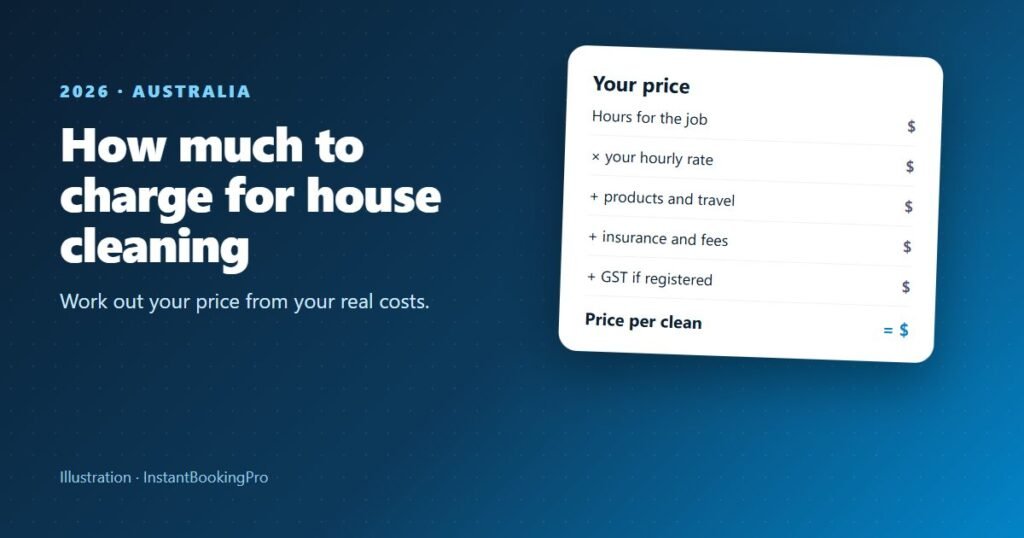
Work out what to charge for house cleaning from your own numbers, not someone else’s price list: (hours for the job × your hourly rate) + supplies + travel + your share of overheads + profit, then add GST if you’re registered and show customers the total. Your hourly rate has to cover your time, tax, super and insurance. If you employ cleaners through a contract cleaning business, the Cleaning Services Award sets the minimum pay, from $27.08 an hour for a full-time Level 1 employee from 1 July 2026, before super. Official sources are below, checked 19 October 2026.
General information only. This guide isn’t financial, tax or employment advice. Your costs, award coverage and tax depend on your situation, so check the official sources linked here and talk to a registered tax agent or adviser.
We don’t publish “average” cleaning prices. They vary by city, suburb, job type and what’s included, and a number you copy from elsewhere won’t tell you whether you make money. This guide shows you how to build a price that does.
Step 1: Know how long each job takes
Time a few real jobs from arrival to departure, including set-up and pack-up. Then group your work into a short menu of standard cleans, priced by property size:
- Standard or regular clean by bedrooms and bathrooms, for example “2 bedrooms, 1 bathroom”.
- Deep or spring clean takes longer than a regular clean of the same home.
- End-of-lease clean is usually the longest, with a fixed checklist.
- Extras such as ovens, inside windows or fridges, each with its own time.
Be honest about billable hours: travel, quoting, admin and gaps between jobs aren’t paid, so count only the hours you’ll actually spend cleaning.
Step 2: Work out your hourly rate
Your rate has to cover more than your take-home pay.
If you clean yourself (sole trader)
- What you want to earn for the year, divided by the hours you’ll realistically bill.
- Super for yourself. Include what you plan to put away for retirement.
- Tax. No-one takes it out for you; set money aside.
- Leave and sick days. No work, no pay, so build it into your rate.
If you employ cleaners
The Cleaning Services Award covers employers in the contract cleaning industry and their employees, including house and apartment cleaners employed by a contract cleaning business (Fair Work Ombudsman: Cleaning Award summary). Minimum rates for a Cleaning Services Employee Level 1 from 1 July 2026:
| Level 1 employee | Minimum hourly rate |
|---|---|
| Full-time | $27.08 (weekly $1,028.90) |
| Part-time | $31.14 |
| Casual | $33.85 |
| Full-time, Saturday / Sunday / public holiday | $40.62 / $54.16 / $67.70 |
Source: Fair Work Ombudsman pay guide, Cleaning Services Award [MA000022], published 24 June 2026. Rates are minimums before super; check the pay guide for your employees’ level and hours. On top of wages, employers pay:
- Super guarantee at 12%, and with Payday Super from 1 July 2026, at the same time as wages (ATO: super guarantee).
- Workers compensation insurance, which employers must get from an authorised insurer (business.gov.au).
- Portable long service leave levies in some states. For example, contract cleaning employers in Queensland pay a levy of 0.5% of workers’ ordinary wages from 1 July 2026 (QLeave), and in the ACT contract cleaning is part of the Services Industry Scheme, with a levy set at 1.07% at commencement (ACT Leave). NSW and Victoria have schemes too (NSW, Victoria); check the levy for your state.
- A vehicle allowance if employees use their own car for work: the pay guide lists $1.01 per km.
The award rate is the floor for your labour cost, not your price. Your price also has to cover the time you pay for that isn’t cleaning, supervision, admin and profit.
Step 3: Add your other costs
- Supplies and equipment: products, cloths, vacuums and their replacement.
- Travel: if you use your own car, the ATO’s cents per kilometre rate (88 cents for 2025–26 and 91 cents for 2026–27, up to 5,000 business km per car) is a useful guide to what driving really costs (ATO).
- Insurance: public liability, and anything else your insurer recommends.
- Overheads: phone, software, accounting, advertising, spread across your billable hours.
- Profit: a margin on top, so the business can grow and cope with quiet weeks.
Step 4: Add GST and show the total
Register for GST once your GST turnover reaches $75,000 or more (ATO: registering for GST). GST is 10%, and businesses registered for GST generally include it in their prices. When you advertise to households, the ACCC says businesses must display the total price as a single figure, including taxes and any unavoidable extra fees (ACCC: price displays). Card payment surcharges for Visa, Mastercard, American Express and eftpos are banned from 1 October 2026 (ACCC), so build card fees into your prices.
Putting it together
For each standard clean on your menu:
Price = (hours for the job × your hourly rate) + supplies + travel + share of overheads + profit, then GST if registered.
Example method for a business employing a casual Level 1 cleaner on a weekday: 3 hours × $33.85 = $101.55 in wages, plus super at 12% and any portable long service leave levy, plus workers compensation, before supplies, travel, overheads, profit and GST. That’s the cost floor for the job, not the price to charge.
Then sense-check against what local cleaning businesses advertise for the same scope, and compete on what’s included and how easy you are to book, not on being the cheapest.
Hourly rate or flat price?
- Flat prices per job (by bedrooms and bathrooms) are easier for customers to compare and book online, and reward you for working efficiently.
- Hourly rates suit unpredictable work, but customers can’t see the final cost upfront.
- Many cleaners use flat prices for standard cleans and quote unusual jobs separately.
Publish your prices and take bookings online
Customers trust a published price more than “call for a quote”. With your own booking page:
- Each clean is its own service with its own time and price, such as “Standard clean, 2 bedrooms” or “End-of-lease clean, 3 bedrooms, 2 bathrooms”. There aren’t separate bedroom fields; each size is a service.
- Customers book themselves into times that are genuinely free, based on your hours and days off.
- The booking notes hold the address and access details.
- Customers agree to your cancellation policy before they book; see what to put in a cancellation policy.
It doesn’t take payments or send reminders. See it for cleaning businesses, or try the live booking demo. Starting out? Read how to start a cleaning business in Australia and how to get your first 10 customers.
Ready to publish your prices? We’ll set up your booking page with your cleans, times and prices, and a website if you want one. Booking from $59 a month including GST, typically live within 24 hours.
Frequently asked questions
How much should I charge for house cleaning in Australia?
How much should I charge per hour for cleaning?
Does the Cleaning Services Award apply to me?
Should I charge by the hour or by the job?
Do I charge GST on cleaning?
Can I add a card surcharge?
Official sources checked on 19 October 2026. Award rates, levies and thresholds change; confirm current details on the linked pages.
Get instant online bookings
We build and launch your branded booking system for you — typically live within 24 hours.