How to Start a Mobile Car Detailing Business in Australia (2026)
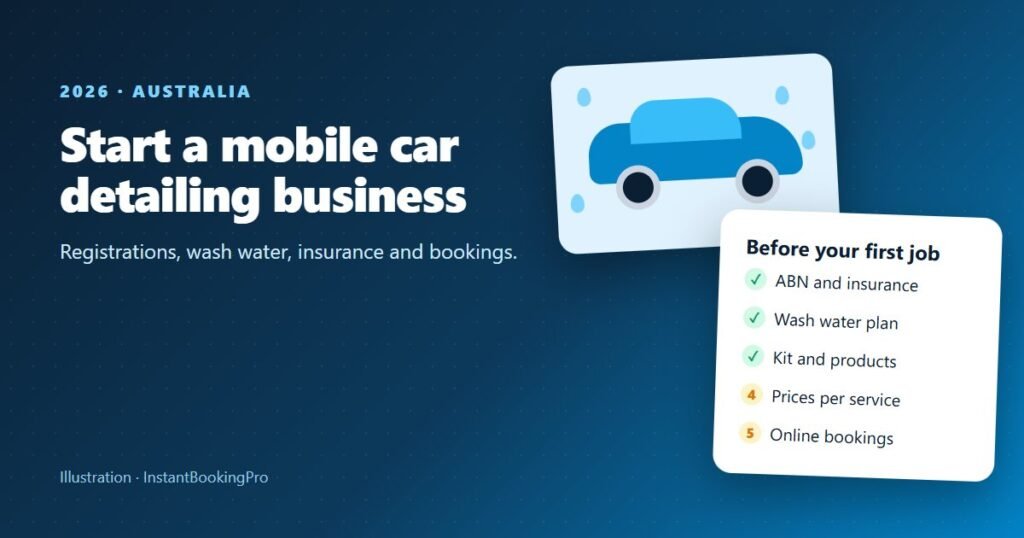
To start a mobile car detailing business in Australia: get a free ABN, register a business name if you won’t trade under your own name ($47 for 1 year), arrange public liability insurance, and above all plan where your wash water goes. Environment regulators say wash water and detergents must not run into the gutter or stormwater drain, and that includes “biodegradable” products. Then check with your council about working from home or in public car parks, set prices from your real time and costs, and make it easy for customers to book. Official links for each state are below, checked 19 October 2026.
General information only. This guide isn’t legal, tax or financial advice. The rules depend on your state or territory, your council, your water utility and where you work, so check your own situation with the official sources linked here, your council or a registered tax agent or adviser.
A mobile detailing business needs a vehicle, a good kit and customers. The part new detailers most often miss is the water. Washing a car on a street or driveway is exactly the kind of run-off stormwater rules are written for. Here’s what to sort out, in order.
What do I need to start a mobile car detailing business?
- An ABN It’s free to register through the Australian Business Register (business.gov.au: register for an ABN).
- A business name Needed if you trade under any name other than your own: $47 for 1 year or $108 for 3 years from 1 July 2026 (business.gov.au: register your business name).
- Insurance Public liability “covers you if someone dies, gets injured or has their property damaged because of your negligence”. business.gov.au also lists portable equipment insurance for tools you take to jobs, and workers compensation once you employ staff (business.gov.au: types of business insurance). Ask your insurer or broker how you’re covered for damage to a customer’s car while you’re working on it.
- A wash water plan A wash mat with raised sides to capture water, a way to store it, and somewhere approved to dispose of it. See the state table below.
- Council checks Ask about a home-based business, and about working on streets or in public car parks.
- Your kit and chemicals Keep the safety data sheet (SDS) for each hazardous chemical you use.
- Prices and bookings A clear list of services with times and prices, and an easy way for customers to book.
Wash water and stormwater rules by state
Stormwater drains go straight to creeks, rivers and the sea, without treatment. EPA Victoria puts it simply: “Only rainwater should go down stormwater drains.” This is a summary of each official page as it read on 19 October 2026. Check the page for your state, and ask your council and water utility before you start.
| State | What the official page says |
|---|---|
| Victoria | If you can’t take vehicles to a wash bay, “use a mobile wash mat to collect wastewater”. You need a trade waste agreement with your water corporation before you can dispose of industrial waste to sewer, and the general environmental duty applies. Source: EPA Victoria |
| New South Wales | “Strictly speaking, it is an offence to wash a car in any place where the water drains into the stormwater system.” Discharging to sewer needs approval from your local sewerage authority. Water pollution penalty notices are $15,000 for an individual’s first offence. Source: NSW EPA (smash repair industry guidance), NSW EPA penalties |
| Queensland | Waste water from outdoor cleaning is listed as a contaminant when it’s released into roadside gutters or stormwater drainage, and “for most water contamination issues you should talk to your local government”. Check with your council about mobile washing. Source: Queensland Government |
| South Australia | “Wastewater and detergents from washing of vehicles must not go to the stormwater system.” If chemicals are used, wash on a mat with bunded sides and capture all wastewater for disposal at a licensed facility. Without chemicals, washing on grass or garden areas away from stormwater entry points is possible. Non-compliance may bring a $300 fine, an Environment Protection Order or prosecution. Source: EPA SA |
| Western Australia | The Water Quality Protection Note for mobile cleaning (2013) says washing of soil and road grime (not oils) “should be carried out on turf”, and liquid waste should not drain into stormwater. Treated water may go to sewer only if the sewerage service provider approves. Source: WA Government (DWER), WQPN 29 |
| Tasmania | Check with your council and the EPA. Source: EPA Tasmania |
| ACT | A person washing vehicles as part of a commercial activity commits an offence if they allow run-off “to enter a waterway” (a strict liability offence). The automotive trades code of practice applies to mobile services and says wash water not recycled should go to sewer with Icon Water’s approval. Source: Environment Protection Regulation 2005 (ACT), s 48, Automotive Trades Code of Practice |
| Northern Territory | Check with your council and the NT EPA. Source: NT EPA |
“Biodegradable” doesn’t mean drain-safe. EPA SA says biodegradable products “are not safe to discharge into stormwater, as they are only broken down by organisms in the sewage treatment process” (EPA SA guide for mobile car detailers). Waterless and rinseless products, a wash mat and a recovery tank are common ways detailers keep water out of the gutter.
Water use rules
Permanent water rules can limit how you wash. In Greater Sydney you can wash vehicles any time with a bucket and sponge, a hose with a trigger nozzle or high-pressure cleaning equipment (Sydney Water: Water Wise Guidelines). Melbourne’s permanent water saving rules allow the same methods (Yarra Valley Water). Seqwater says no restrictions are in place in South East Queensland (Seqwater). Elsewhere, check your water utility.
Do I need council approval?
Possibly, in two ways:
- Running the business from home. business.gov.au says “you may need approval from your local government or council”, for example if clients visit, you put up signs or you’ll use a lot of water (business.gov.au: home-based businesses). Tell your home insurer too: standard home policies often don’t cover business activities.
- Working on streets or in public car parks. Some councils require a permit to occupy a road, footpath or car park, usually with proof of public liability insurance. Check with your local council before you work anywhere other than a customer’s own property.
The Australian Business Licence and Information Service (ABLIS) lists the licences and approvals for your business type and location.
Chemicals and safety
Safe Work Australia says you must keep copies of the safety data sheet (SDS) for the hazardous chemicals you use in your hazardous chemical register, and make them easy to access for workers who use them (Safe Work Australia: using safety data sheets). You can get an SDS from the manufacturer’s website or by asking the supplier. Carry a spill kit in the vehicle.
Your vehicle and tax
If you use your own car, the ATO’s cents per kilometre rate is 88 cents for 2025–26 and 91 cents for 2026–27, for up to 5,000 business kilometres per car a year. Above that you need the logbook method, kept for at least 12 continuous weeks. Companies and trusts can’t use the cents per kilometre method (ATO: motor vehicle expenses). Register for GST once your GST turnover reaches $75,000 or more, or when you expect it to (ATO: registering for GST). A registered tax agent can tell you what applies to you.
How to price mobile detailing
We don’t publish “average” detailing prices, because they depend on your area, your kit and how long you really take. Work out your own:
- Time each service Include set-up, laying the wash mat, pack-down and water disposal, not just the detail itself.
- Set your hourly target What you need to earn per working hour, after counting the hours you’ll spend driving, quoting and doing admin.
- Add your costs Products, water and disposal, vehicle running costs, insurance and software.
- Price by vehicle size A 4WD or people mover takes longer than a hatchback, so give it its own price.
- Add GST if you’re registered Show customers the full price they’ll pay.
Then check your prices against what local detailers advertise, and adjust what’s included rather than racing to the bottom.
Taking bookings
Customers looking for a mobile detailer usually want to pick a time, not wait for a text back while you’re on a job. With your own booking page:
- Each service has its own time and price. If you charge more for larger vehicles, set each size up as its own service, for example “Full detail, sedan” and “Full detail, 4WD”.
- Customers book themselves 24/7 into times that are genuinely free, so you don’t double book.
- Your hours, breaks and days off are respected. Set each service’s time long enough to cover set-up and pack-down.
- The address goes in the booking notes. There’s no separate address field, so customers use the notes for the address, where the car will be and any access details.
- Customers agree to your cancellation policy before they book, and can cancel online.
It doesn’t handle payments, reminder messages or travel time between jobs, so leave room in your day for driving. See how it works for car washes and detailers, or try the live booking demo. To find your first customers, read how to get your first 10 customers and how to set up Google Business Profile without a shopfront, then add a Book now button to Instagram and Google.
Starting your detailing business? We’ll set up your booking page, and a website if you want one, so customers can book you from day one. Booking from $59 a month including GST, typically live within 24 hours.
Frequently asked questions
Do I need a licence to start a mobile car detailing business?
Can I wash cars on the street or in a driveway?
Are biodegradable car wash products OK to wash into the drain?
How much does it cost to start a mobile car detailing business?
What insurance does a mobile detailer need?
How do I take bookings for a mobile detailing business?
Official sources checked on 19 October 2026. Rules, fees and rates change; confirm current details on the linked government pages and with your council and water utility.
Get instant online bookings
We build and launch your branded booking system for you — typically live within 24 hours.